Do you really understand what it means to pull 12–14 hour shifts in a professional kitchen?
Not the romanticized version.
Not the Netflix version.
The real one.
The heat.
The pressure.
The noise.
The repetition that never ends.
The emotional marathon that resets every single service.
This article is not about nostalgia.
Not about “how tough it used to be.”
And definitely not about glorifying suffering.
It’s about why burnout became normalized in kitchen culture,
why people are leaving hospitality in record numbers,
and why pretending this is “just how it is” will eventually collapse the industry.
the physical truth: kitchens are brutal
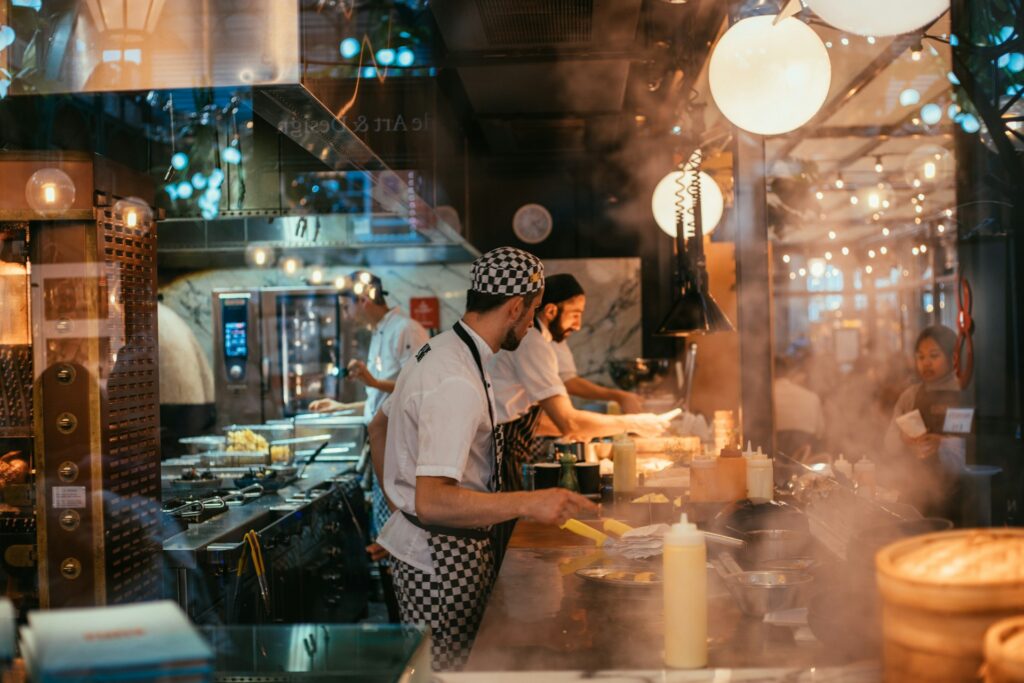
Your back aches before service even starts.
Your knees grind against concrete floors that never forgive.
Your feet burn from standing still and moving fast at the same time.
Your hands tell the real story.
Cuts layered over burns.
Blisters on top of calluses.
Skin that peels because it never gets time to heal.
After a while, something strange happens.
You stop noticing.
Not because it doesn’t hurt –
but because your body adapts to pain as a baseline.
And yet, despite all of this, many people still love the job.
That moment on the line, deep in service, when the printer won’t stop screaming and your station is chaos – and suddenly everything clicks.
Focus sharpens.
Movement becomes instinct.
Time disappears.
That flow is addictive.
That intensity is real.
People don’t leave kitchens because they stop loving cooking.
They leave because the environment no longer lets them love it.
the myth of the 8-hour shift
Let’s be honest.
Does anyone in hospitality actually work eight hours and go home?
Rarely.
Extra hours became part of the culture.
Unpaid time became invisible.
Exhaustion became expected.
We built a system where longer shifts equal commitment,
where suffering equals passion,
where burnout is worn like proof of loyalty.
That logic is outdated.
And it’s destructive.
Some restaurants advertise four-day workweeks – then compress 12–14 hour shifts into those days.
It looks modern.
It sounds progressive.
But the body doesn’t care about branding.
Burnout doesn’t care about scheduling language.
That “flex” stops being impressive when your posture collapses at 40
and your energy never fully recovers.
The problem was never hours alone.
The problem is pretending this level of exhaustion is sustainable.
the uncomfortable truth: the economics are broken
This is the part most people avoid.
Independent restaurants cannot realistically afford the working conditions modern professionals deserve.
Consider what “doing it right” actually requires:
Fair salaries.
Manageable shifts.
Real days off.
Skilled staffing levels.
Quality ingredients.
Rising rent.
Energy costs.
Suppliers.
Maintenance.
Marketing.
Training.
Leadership that isn’t physically breaking on the line.
Now do the math.
For most small operations, it doesn’t add up.
This is why so many independent restaurants struggle.
This is why closures are constant.
And this is why the future is shifting toward groups, collectives, and multi-outlet models.
Larger structures can absorb costs, scale systems, offer benefits, and distribute pressure.
Most independents cannot.
Romanticizing the lone-hero restaurant owner doesn’t fix this.
Adapting business models does.
why the old-school culture is collapsing
Kitchen culture was built on hierarchy, discipline, and sacrifice.
Some of that created excellence.
Much of it created trauma.
We normalized behaviors that would be unacceptable in any other industry:
Yelling framed as leadership.
Overwork framed as loyalty.
Burnout framed as ambition.
No breaks framed as efficiency.
Mental health framed as weakness.
Ask people who left kitchens why they walked away.
They don’t say:
“I hated cooking.”
They say:
“I loved the craft – but the culture destroyed me.”
The passion never died.
The tolerance for abuse did.
the new era: kitchens must evolve or disappear
Hospitality cannot be fixed by nostalgia.
It must be rebuilt for reality.
That means change at every level:
1. people are not machines
Pain is not a motivational tool.
Fear does not create loyalty.
2. mentorship must return
Real teaching.
Clear guidance.
Standards explained – not screamed.
3. discipline without humiliation
You can demand excellence without destroying confidence.
4. pay must reflect skill
Passion does not pay rent.
Respect includes compensation.
5. rest is not weakness
Recovery enables growth.
Exhaustion kills creativity.
6. leadership must evolve
Running a modern kitchen with 1990s logic no longer works.
Restaurants that refuse to change won’t fail because people don’t want to work.
They’ll fail because no one wants to be sacrificed.
why this matters more than ever
Hospitality isn’t dying.
What’s dying is the belief that suffering equals value.
Young chefs are smarter.
They travel more.
They compare more.
They have options.
Private dining.
Consulting.
Brand work.
Hotels.
R&D kitchens.
Content.
Luxury service.
Restaurants must earn loyalty – not demand sacrifice.
Respect is the new currency.
the cost of ignoring burnout culture
When burnout becomes normal, quality drops silently.
Creativity shrinks.
Consistency breaks.
Care disappears.
Not because people don’t try –
but because exhaustion leaves nothing to give.
Burnout doesn’t just destroy individuals.
It destroys guest experience, reputation, and long-term sustainability.
A kitchen without energy cannot create excellence.
what actually keeps people in kitchens
Not suffering.
Not fear.
Not pressure.
People stay when they feel:
Respected.
Challenged.
Supported.
Seen.
Taught.
Protected.
They stay when work has rhythm instead of chaos.
When standards exist without cruelty.
When leadership understands limits.
That’s not softness.
That’s intelligence.
what are you doing to make this industry better?
Are you improving it?
Protecting your people?
Changing systems?
Or repeating habits because “that’s how it’s always been done”?
Hospitality doesn’t need martyrs.
It needs leaders.
People will always love cooking.
They’re just done paying for it with their health.
the future of kitchen culture
The next generation of great kitchens will not be defined by how hard people suffer.
They will be defined by:
Clear systems.
Strong leadership.
Real mentorship.
Sustainable pacing.
And standards that don’t require destruction.
Excellence doesn’t need burnout.
It needs clarity.
final thought
People will always love cooking.
They will always love service.
They will always love creating moments that matter.
They are not asking for luxury.
They are asking for dignity.
If hospitality can’t provide that,
there won’t be an industry left to romanticize.
If you want help implementing modern techniques, training your team, or bringing innovation into your kitchen — you know where to find me.
If this inspired you, follow me Norbert Jacniak : https://www.linkedin.com/in/norbert-jacniak/
Subscribe to my newsletter: https://www.linkedin.com/newsletters/culinary-intelligence-more-7374102977458016256/
And step behind the curtain of the world’s most exclusive tables.
Because luxury isn’t what you buy.
It’s what you build.