The hospitality industry talks endlessly about standards and performance – yet it still ignores the one factor that truly creates elite teams: ownership.
Not equity. Not profit share.
But psychological ownership – the identity-level feeling of “the outcome reflects me.”
This article explores why salary can only buy attendance, why ownership drives excellence, and why the next era of hospitality will be led by teams who feel they have a stake in what they build.
the Michael Jordan lesson leaders still ignore
The hospitality industry talks endlessly about passion, precision, consistency, cost control, guest experience and “standards.”
But it avoids the one element that actually creates elite performance:
Ownership.
Not shares.
Not equity.
Not profit cuts.
Not financial ownership.
Psychological ownership.
The feeling of: “What happens here reflects me.”
That is the real engine of performance – not the paycheck, not the hierarchy, and definitely not the endless “we are a family” leadership clichés.
And this is exactly where hospitality still underperforms on a global scale.
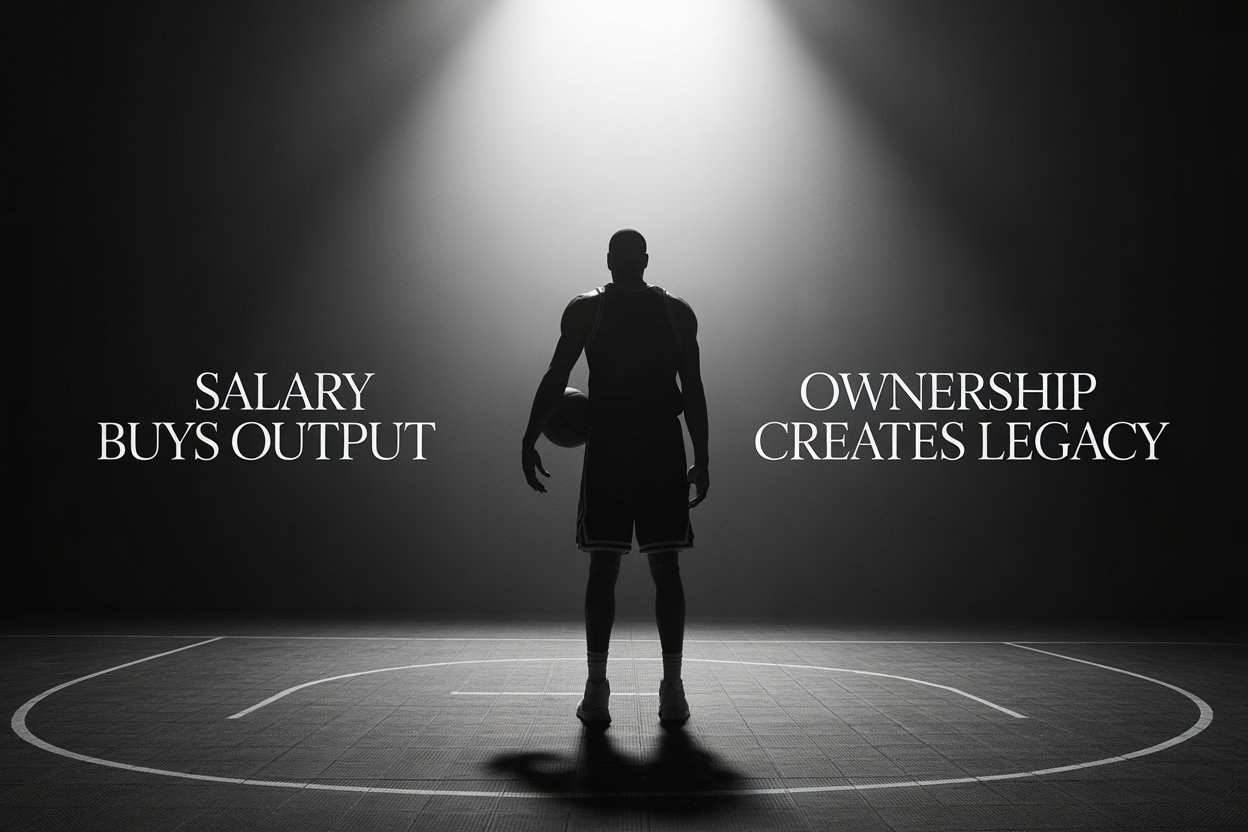
salary buys output. ownership creates identity.
A salary creates a transaction:
You show up. You complete tasks. You receive money.
That is not loyalty.
That is not vision.
That is not long-term thinking.
It is attendance.
This is not a criticism – it is reality.
People respond to the structure they are given.
But the moment you give someone ownership – real or symbolic – everything shifts:
• Their judgement elevates.
• Their standards rise automatically.
• Their decision-making matures.
• They think beyond the shift, beyond the checklist, beyond the today.
• They take responsibility for details nobody asked for.
Salary produces: “my job.”
Ownership produces: “our result.”
And guest experience is an emotional product.
You cannot KPI intuition.
You cannot spreadsheet caring.
You need people who voluntarily operate like they have skin in the game.
the Michael Jordan lesson – the one hospitality leaders always overlook
Everyone knows the Air Jordan line became a billion-dollar empire.
But the real lesson is simpler:
Nike didn’t buy Jordan’s performance.
Nike bought his participation.
He wasn’t a mascot.
He wasn’t a poster boy.
He wasn’t a passive ambassador.
He helped shape the product itself:
• Designs
• Comfort
• Aesthetic decisions
• Narrative
• Positioning
• Authenticity
When people influence the product, their standards rise naturally – because their identity is now connected to the outcome.
This is exactly what hospitality consistently ignores.
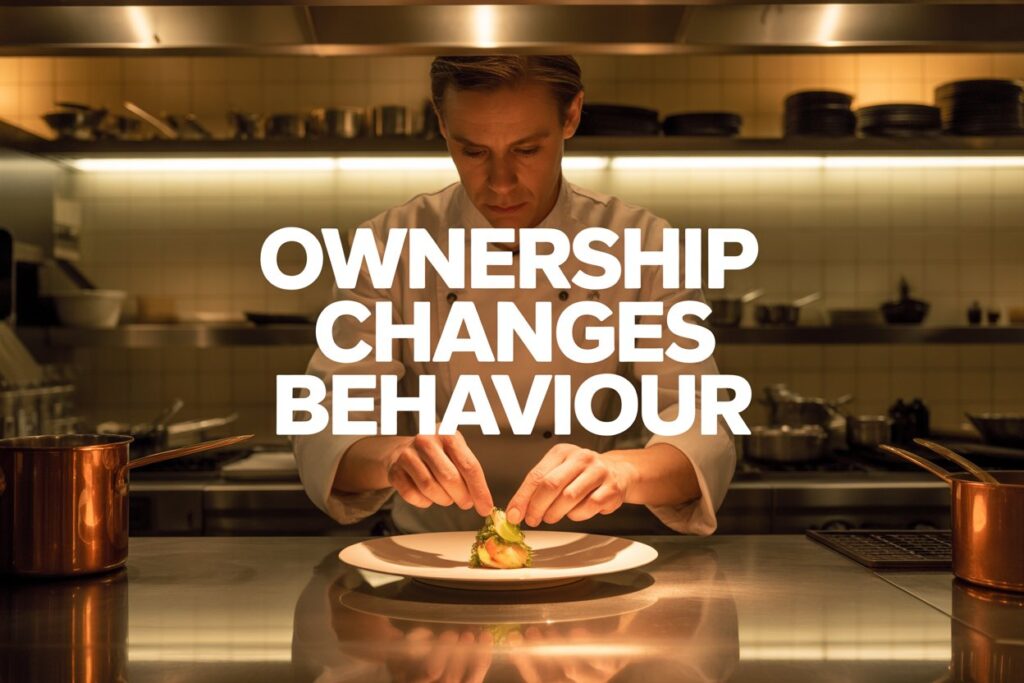
Ownership changes behaviour because it changes identity.
What ownership actually looks like in restaurants and hotels
Most operators still think “ownership” means equity.
It doesn’t.
Often, ownership means giving someone territory – a meaningful area of responsibility where their decisions matter.
Examples:
• A sommelier not just executing pairings, but shaping them.
• A chef de partie not just cooking their station, but influencing the guest journey.
• A bartender not just making drinks, but developing signatures that carry their name.
• A supervisor improving systems instead of waiting for permission.
• A head waiter shaping service flow, not only following it.
These people don’t “help.”
They build.
Their fingerprint becomes visible in the experience.
And that is where performance excellence comes from.
why most hospitality businesses still fail to create ownership
Because they confuse loyalty with ownership.
Loyalty is emotional.
Ownership is structural.
Loyal people support you.
People with ownership build with you.
But many leaders still avoid creating ownership culture, because real ownership requires:
• Transparency
• Shared credit
• Trust
• Autonomy
• Clear standards
• Inclusion
• Letting go of micro-control
Most concepts stagnate because everything flows through one person — usually the owner or executive chef.
That is not leadership.
That is bottlenecking.
The invisible cost of non-ownership teams
When people don’t have a stake, they rationally choose:
• Compliance instead of initiative
• Repetition instead of creativity
• Short-term thinking instead of care
• “My job” instead of “our outcome”
• Safety instead of responsibility
Why take ownership for something you cannot influence?
That behaviour is not a weakness – it is a logical survival strategy inside the wrong structure.
⸻
What “giving a stake” actually looks like (without giving away equity)
• Let people shape parts of the concept
• Give autonomy to improve systems
• Trust them with standards
• Let them lead within their domain
• Recognize contribution publicly and consistently
• Involve them in creative or strategic decisions
• Accept their influence on the product
Ownership = responsibility + influence.
Not fake empowerment.
Real inclusion.
why i personally work the way i work
I am self-employed for a simple reason:
Ownership pushes me to a performance level no salary ever could.
When I create a menu – it’s mine.
When I design a guest journey – it’s mine.
When I build an experience – it’s mine.
When I consult a business – the result reflects me.
Not ego.
Responsibility.
The weight forces excellence.
The pressure sharpens judgment.
The freedom expands creativity.
This is not hustle.
This is not grinding.
This is craftsmanship shaped by ownership.
shared ownership reduces leadership pressure
Most leaders burn out because they keep ownership for themselves:
• All responsibility
• All vision
• All consistency
• All guest experience
• All long-term thinking
• All culture management
Of course that collapses.
But when ownership is shared intelligently:
1. Standards rise naturally
2. Team members self-regulate
3. Culture reinforces itself
4. Emotional weight distributes
5. Micro-leadership appears everywhere
This is how elite teams are built – not through fear, not through hierarchy, not through speeches, but through shared stake.
why ownership culture will dominate hospitality between 2025–2030
Because the industry is at a breaking point:
• Talent shortages
• Declining loyalty
• Rising guest expectations
• Record burnout
• Oversupply of “nice but empty” concepts
• Fierce global competition
• Zero patience for leaders who micro-control everything
Salary doesn’t fix any of this.
Audits don’t fix this.
Motivational posters and “staff pizza night” definitely don’t fix this.
Ownership does.
Hospitality is moving into a decade where experience, narrative and identity matter more than ever – and identity only emerges when people have a stake.
the real question leaders must start asking
Not:
“Why doesn’t my team care more?”
But:
“What do they stand to lose if they don’t?”
People protect what they help build.
It’s that simple.
If you want initiative – give room.
If you want care – give responsibility.
If you want excellence – give a stake.
If you want retention – give identity.
If you want a future – build ownership culture.
This is the real transformation coming for hospitality.
If you’ve read until here – then you already understand the point
my business is not defined by a fixed destination.
It’s defined by:
Movement.
Curiosity.
Encounters.
Freedom.
Responsibility.
Craftsmanship.
Ownership.
The next 36 meetings will be more interesting than the last 36 – because when you build a life based on ownership, not salary, anything can happen.
And it usually does.
If you want deeper insights on luxury dining, modern hospitality, and culinary psychology…
Follow Norbert Jacniak : https://www.linkedin.com/in/norbert-jacniak/
Subscribe to my newsletter: https://www.linkedin.com/newsletters/culinary-intelligence-more-7374102977458016256/
And step behind the curtain of the world’s most exclusive tables.
Because luxury isn’t what you buy.
It’s what you build.